


Short answer: There is no neutral ranking of AI app development agencies. Shortlist the ones that can show you how they test AI output (evals), cap model cost per user, disclose third-party AI data sharing the way Apple requires and tell EU users they are talking to AI, and test for prompt injection before launch. Ask each one the six questions below, and choose the team that answers with examples from shipped products, not demos.
Why is an AI app harder to ship than a normal app?
A normal feature either works or it does not. An AI feature gives a slightly different answer each time, can be steered by what users type, and costs money on every request. That changes what "done" means.
The 2025 DORA report found that AI adoption now has a positive relationship with delivery throughput, but delivery instability continues to rise, and it describes AI as an amplifier of a team's existing strengths and weaknesses. An agency with weak testing and review can ship AI features faster and break them faster.
What should an AI app agency show you before you sign?
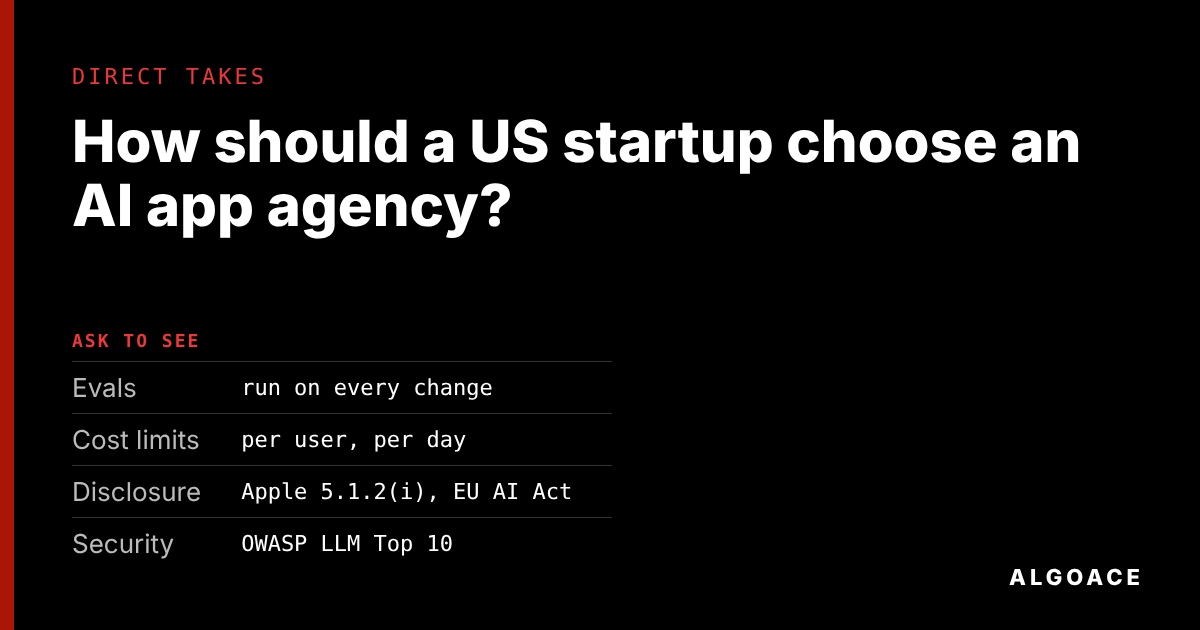
- Evals. A written set of test inputs with expected behavior for each AI feature, run on every change, with a pass rate the agency tracks. Ask to see one from a shipped product (with client details removed).
- Cost limits. How they cap model spend per user and per day, what happens when a user hits the cap, and how they log token use. OWASP lists unbounded consumption as one of the top 10 risks for LLM applications.
- Privacy and disclosure. Apple's App Review Guidelines (5.1.2(i), clarified 13 November 2025) require apps to clearly disclose where personal data is shared with third parties, including third-party AI, and to get explicit permission first. Ask where that consent screen goes in your app.
- Security testing. Which of the OWASP Top 10 for LLM Applications they test for before launch, especially prompt injection, sensitive information disclosure and excessive agency, and who runs those tests.
- Model vendor terms. Which model providers they use and what those providers do with your data. For example, OpenAI says it does not train on API inputs or outputs by default, and qualifying organizations can configure retention, including zero data retention.
- Who builds and who reviews. The names of the engineers who will write the code, who reviews every pull request, and whether any work is subcontracted.
Which rules apply to an AI app in 2026?
Rule | Applies when | What it asks for |
|---|---|---|
Apple App Review Guideline 5.1.2(i) (updated 13 Nov 2025) | Your iOS app shares personal data with a third party, including a third-party AI service | Clear disclosure and explicit permission before sharing |
EU AI Act transparency rules (in effect 2 Aug 2026) | Users in the EU interact with a chatbot, AI agent or avatar, or you publish certain AI-generated content | Tell users they are interacting with AI; label certain AI-generated content |
California SB 243 (in effect 1 Jan 2026) | Your chatbot is designed to meet users' social or emotional needs (customer service bots are excluded) | AI disclosure where a person could be misled; for known minors, AI disclosure and a break reminder at least every 3 hours; a crisis referral protocol published on the website; annual reporting from 1 Jul 2027 |
This table is a starting point, not legal advice. Check with counsel for your markets.
Which OWASP risks matter most for a startup's first AI feature?
The OWASP Top 10 for LLM Applications 2025 lists ten risks. Four map directly to what most first AI features include: free text input, connected data, actions and metered model calls.
- LLM01 Prompt injection: a user, document or web page tells the model to ignore its instructions.
- LLM02 Sensitive information disclosure: the model exposes personal data, credentials or another user's data, directly or through a connected tool.
- LLM06 Excessive agency: the model can take actions (send email, change records, spend money) without a human check.
- LLM10 Unbounded consumption: one user or a script drives up your model bill or takes the service down.
Ask the agency how each is handled in the design, and how each is tested.
How do you compare the shortlist?
Send every agency the same one-page brief and ask for a written plan with the six answers above, a fixed price per milestone, and the first thing you will be able to test, with the date. Then compare:
- Do they name the evals and show one, or talk about "accuracy" in general?
- Do they name the rules that apply to your app without being asked?
- Is the first milestone something you can test with real users, or a slide?
Where does Algoace fit?
Algoace is one option: a senior-led software and AI studio with offices in Karachi and Sharjah, founded 2018, with 400+ projects delivered. It builds AI features into mobile and web apps and runs AI evaluation and red teaming as a separate service. Ask it the same six questions in a scoping call. You are never handed to a junior or a subcontractor. Your product is yours, completely.
Sources
- Apple Developer, Updated App Review Guidelines now available (13 Nov 2025): https://developer.apple.com/news/?id=ey6d8onl (read 24 Nov 2026)
- OWASP GenAI Security Project, Top 10 for LLM Applications 2025: https://genai.owasp.org/resource/owasp-top-10-for-llm-applications-2025/ (read 24 Nov 2026)
- European Commission, Safer and more transparent AI (2 Aug 2026): https://commission.europa.eu/news-and-media/news/safer-and-more-transparent-ai-2026-08-02_en (read 24 Nov 2026)
- Perkins Coie, California companion chatbot law now in effect: https://perkinscoie.com/insights/update/california-companion-chatbot-law-now-effect (read 24 Nov 2026)
- OpenAI, Business data privacy, security and compliance: https://openai.com/business-data/ (read 24 Nov 2026)
- InfoQ, DORA 2025 State of AI-assisted Software Development (29 Sep 2025): https://www.infoq.com/news/2025/09/dora-state-of-ai-in-dev-2025 (read 19 Nov 2026)
Questions this raises
What are the best AI app development agencies for startups in the US?
There is no neutral ranking. Shortlist agencies that can show evals from a shipped product, explain how they cap model cost per user, handle AI data-sharing disclosure, and test for prompt injection before launch. Compare written plans for the same brief.
What are evals in AI app development?
Evals are a fixed set of test inputs with the expected behavior for an AI feature. They run on every change, so the team can see whether a new prompt, model or code change made answers better or worse before users do.
Does my app need to tell users it uses AI?
Often, yes. Apple requires clear disclosure and explicit permission before an app shares personal data with third-party AI. The EU AI Act requires telling users in the EU when they interact with an AI system (from 2 August 2026), and California SB 243 adds rules for companion chatbots. This is not legal advice; check with counsel.
Will the AI provider train on my users' data?
It depends on the provider and the plan. OpenAI, for example, says it does not train on API data by default and lets qualifying organizations set retention, including zero data retention. Ask your agency which providers it uses and to show their current terms.
What is prompt injection?
Prompt injection is when text from a user, a document or a web page tells the model to ignore its instructions, for example to reveal hidden data or take an action it should not. It is first on the OWASP Top 10 for LLM Applications 2025.