

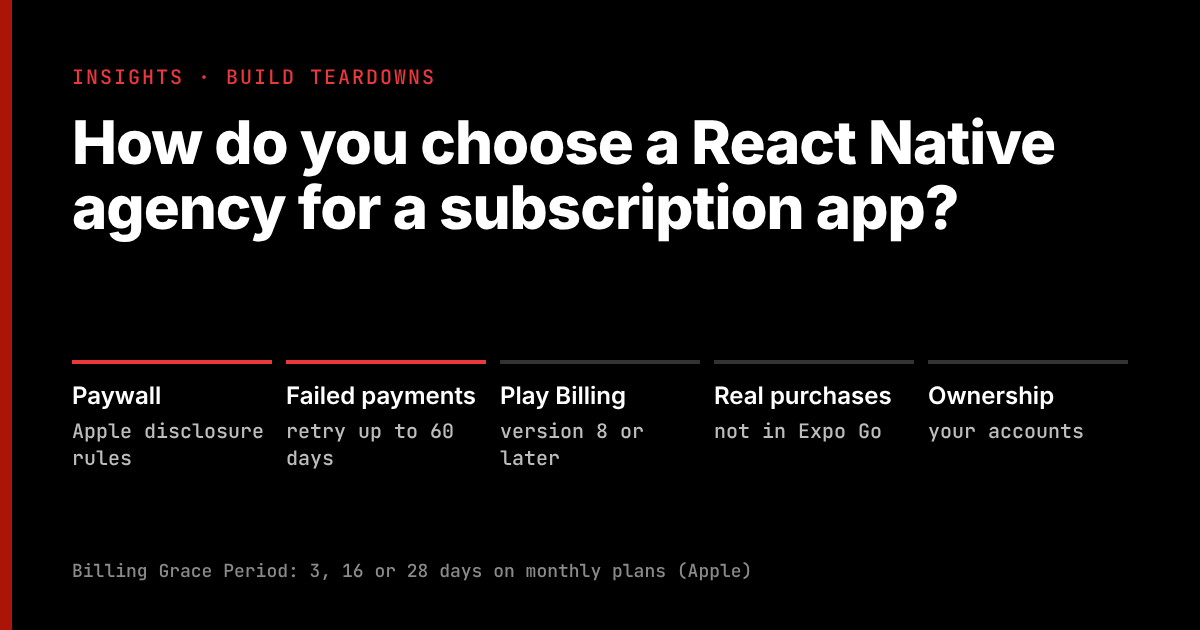
Short answer: No neutral ranking of React Native agencies exists, so judge each one on the parts of a subscription app that fail quietly. Ask them to show you a paywall that meets Apple's disclosure rules, how they handle failed renewals and grace periods, which Google Play Billing Library version they ship, how they test real purchases outside Expo Go, and whose accounts the app, the store listings and RevenueCat live in. Then compare portfolios.
What does a subscription app need that a normal React Native app does not?
Most of the risk sits in a small number of screens and server events. A team that has shipped subscription apps will raise these before you do:
Area | What must be right | Where it is defined |
|---|---|---|
Paywall and sign-up screen | Subscription name and duration, what is included, full renewal price as the most prominent price, trial length and the price after it, restore, Terms and Privacy links | Apple, Auto-renewable subscriptions |
Failed renewals | Billing retry for up to 60 days, optional grace period of 3, 16 or 28 days for monthly and longer plans, full access during the grace period | Apple, Reducing involuntary subscriber churn |
Android billing | Google Play Billing Library 8 or later for new apps and updates (version 7 cutoff 31 August 2026, or 1 November 2026 with an extension) | Google table, summarized by RevenueCat |
Entitlements (who has paid access) | One source of truth for who has access, shared by app and server | Our recommendation |
Testing | Real sandbox and test-track purchases on a development build (a test version of your app), not Expo Go (Expo's preview app) | RevenueCat Expo guide |
If an agency's answer to any row is "we use a library for that", ask them to show you how they tested it.
What should you ask about the paywall?
Ask to see a paywall they shipped, then check it against Apple's list. The amount billed must be the most prominent price element; monthly equivalents and savings come smaller and second. The paywall must state the trial length and the price billed after the trial. A current subscriber needs a way to sign in or restore.
Then ask how they change it. Copy and layout tests can run from your subscription platform's remote paywall settings or an over-the-air update for JavaScript changes (EAS Update). Native changes and SDK upgrades still need a store build. A team that can only change the paywall through a new store release will run very few tests.
How should the app handle failed payments?
Ask the agency to walk you through what the user sees on the day a renewal fails. On the App Store, a failed renewal enters billing retry, and Apple keeps trying for up to 60 days. If you turn on Billing Grace Period, the subscriber keeps full access for 3, 16 or 28 days (monthly and longer plans) while Apple retries, and if the payment recovers inside that window, the subscriber never loses access.
A good answer names the server events that say a renewal failed and later recovered (DID_FAIL_TO_RENEW and DID_RECOVER, or the matching webhooks from your subscription platform), shows an in-app message that sends the user to update payment, and does not lock the user out during a grace period.
Which Android billing version should the app ship?
Ask which Google Play Billing Library version the app uses and how it gets updated. Google stopped accepting new apps and updates built on version 7 after 31 August 2026; apps granted an extension had until 1 November 2026. Version 8 removed older calls such as queryPurchaseHistoryAsync and querySkuDetailsAsync, so code that used them has to be rewritten. If the agency uses a subscription SDK, ask which billing version that SDK pins and when they last updated it.
How do they test real purchases?
In Expo Go, RevenueCat's React Native SDK runs in a mock preview mode, so a team that tests only there has never completed a real purchase. Ask for the test plan: sandbox purchases on iOS, a license tester (a Google account allowed to make test purchases) on a Play test track, restore on a second device, an expired trial, a refund, and a renewal that fails. Ask who runs that plan before each release.
What should you see in their portfolio?
Ask for apps that charge a subscription, and ask what they owned: the whole app, the paywall, the billing server, or only the interface. Ask for the store links. If the agency also runs paid acquisition, ask whether purchase events reach your attribution tool.
What trial-to-paid rate is realistic?
Treat medians with care. RevenueCat's 2026 report, covering more than 115,000 apps, puts the median Day-35 trial-to-paid rate at 10.7% for hard paywalls and 2.1% for freemium apps. An agency quoting much higher numbers for your app before launch is guessing.
Who should own the accounts?
You. The Apple developer account, the Google Play console, the subscription platform, the analytics and attribution tools and the repository should be created in your organization from day one, with named access for the agency that you can revoke. Ask the agency to confirm this in the contract, together with a written assignment of the code to your company.
At Algoace, client repositories live in the client's organization by default (see our trust page).
Where does Algoace fit?
Algoace is one option: a senior-led software and AI studio with offices in Karachi and Sharjah, founded in 2018 by Mubeen Nisar, who has built software for clients since 2014. 400+ projects delivered. We offer React Native app engineering and app growth marketing (see also React Native or Flutter for a subscription app). You are never handed to a junior or a subcontractor. Your product is yours, completely.
Sources
- Apple, Auto-renewable subscriptions: https://developer.apple.com/app-store/subscriptions/ (read 19 Nov 2026)
- Apple, Reducing involuntary subscriber churn: https://developer.apple.com/documentation/storekit/reducing-involuntary-subscriber-churn (read 19 Nov 2026)
- RevenueCat, Play Billing Library 8 migration (8 May 2026): https://revenuecat.com/blog/engineering/play-billing-8-migration/ (read 19 Nov 2026)
- RevenueCat, Subscription app trends and benchmarks 2026: https://revenuecat.com/blog/growth/subscription-app-trends-benchmarks-2026 (read 19 Nov 2026)
- RevenueCat, Using RevenueCat with Expo: https://www.revenuecat.com/docs/getting-started/installation/expo (read 12 Nov 2026)
- Expo, EAS Update introduction: https://docs.expo.dev/eas-update/introduction/ (read 12 Nov 2026)
Questions this raises
Who are the best React Native development agencies for a subscription app?
There is no neutral ranking. Shortlist agencies that can show a shipped paywall that meets Apple's disclosure rules, a plan for failed renewals and grace periods, a current Google Play Billing version, real purchase tests outside Expo Go, and accounts created in your organization.
What must an App Store subscription paywall show?
The subscription name and duration, what is included, the full renewal price as the most prominent price, the trial length and the price after it, a way to restore, and links to the Terms of Use and Privacy Policy.
What happens when a subscriber's payment fails on the App Store?
The subscription enters billing retry and Apple tries to collect for up to 60 days. With Billing Grace Period on, the subscriber keeps access for 3, 16 or 28 days on monthly and longer plans while Apple retries.
Which Google Play Billing Library version does a subscription app need?
Version 8 or later. Google stopped accepting new apps and updates on version 7 after 31 August 2026 (1 November 2026 for apps with an extension). Existing installs keep working, but updates are blocked until the app moves up.
Can you test React Native subscriptions in Expo Go?
Only in a mock preview mode. Real purchases need an Expo development build with sandbox accounts on iOS and license testers on a Google Play test track.