


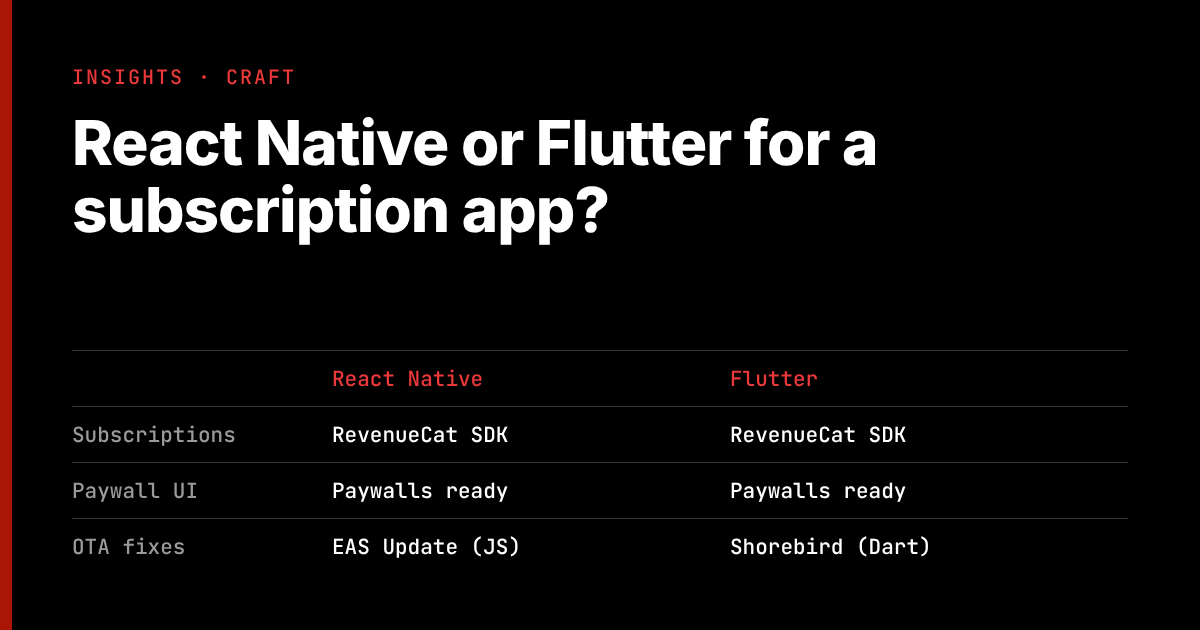
Both React Native and Flutter can run a subscription app well. RevenueCat ships an SDK and ready paywall components for each. Pick React Native when you have or plan a web product, or your team writes TypeScript. Pick Flutter when the app is mobile-only and the interface is heavily custom. 400+ projects delivered since 2014.
Does the subscription layer work the same in React Native and Flutter?
Mostly, yes. The parts that take real engineering time in a subscription app (purchases, receipt validation, entitlements, paywalls, restore, and sending revenue events to your attribution tool) are handled by the same vendors on both frameworks.
Layer | React Native | Flutter |
|---|---|---|
Subscription SDK (RevenueCat) |
|
|
Ready paywall UI |
|
|
Web purchases | Supported through RevenueCat Billing (Stripe), with separate web products | SDK supports web, but presenting paywalls on web is not supported yet |
Attribution (AppsFlyer) | Official React Native plugin | Official Flutter plugin ( |
Two details catch teams out. On React Native with Expo, the RevenueCat SDK runs in a mock "Preview API Mode" inside Expo Go, so real purchases need a development build. On Flutter for Android, the paywall components need your MainActivity to extend FlutterFragmentActivity. Neither is hard, but both belong in the first sprint, not the week before launch.
Can you fix a paywall without waiting for App Store review?
Partly, on both frameworks, and only for code that is not native.
- React Native with Expo: EAS Update ships changes to JavaScript, styling and images over the air: copy, translations, layouts and JavaScript bug fixes. Native code, native dependencies, new permissions and SDK upgrades still need a new store build.
- Flutter with Shorebird: a patch changes only Dart code, for one release version. Native code, assets and the Flutter version need a new store release.
Both rely on Apple's rule that interpreted code may be downloaded, as long as it does not change the app's primary purpose (Apple Developer Program License Agreement, section 3.3.1(B)). In practice: price tests and paywall layouts should be driven by your subscription platform's remote configuration, over-the-air updates are for fixes, and anything that changes what the app does goes through review.
Is one of them faster in 2026?
The old performance argument has narrowed. React Native turned on its New Architecture by default in version 0.76 (October 2024). Flutter's Impeller renderer is the default on iOS and on Android API 29 and later, and older or non-Vulkan Android devices fall back to OpenGL automatically.
For a subscription app, the screens that matter are onboarding, the paywall and the first value moment. They are rarely animation-heavy enough for the framework to decide your conversion. Measure startup time and dropped frames on a mid-range Android phone, because that is where both frameworks show their limits first.
When does React Native win for a subscription app?
- You have, or will have, a web product. TypeScript types, API clients and business logic can be shared with a Next.js app.
- You want a web checkout next to the app stores. RevenueCat's React Native SDK supports web purchases through Stripe.
- Your team already writes React or TypeScript, so hiring and handover are easier.
- You want Expo's build and update tooling, with over-the-air fixes for copy and layout.
When does Flutter win?
- The app is mobile-only and you do not expect to share code with a web product.
- The interface is heavily custom (illustrated onboarding, branded motion, identical rendering on both platforms) and you want one renderer to own every pixel.
- Your team already writes Dart. Retraining costs more than any ecosystem advantage.
What should decide it for your app?
Answer these five questions before you pick:
- Will this product have a web app or a web checkout in the next 12 months?
- What language does the team who will maintain it for the next three years already write?
- How custom is the paywall and onboarding interface, compared with a standard RevenueCat paywall?
- Which SDKs must ship on day one (attribution, analytics, a specific payment or identity provider), and do they support both frameworks today?
- Who will push fixes after launch, and through which path: over-the-air updates or a store release?
If the answers to 1 and 2 point to TypeScript, choose React Native. If the app is mobile-only and question 3 matters most, choose Flutter. If the answers split, the maintaining team's language usually wins, because maintenance outlasts the first build.
Algoace builds subscription apps in both frameworks and has maintained one React Native app for about five years. You are never handed to a junior or a subcontractor.
Sources:
- RevenueCat, React Native installation: https://www.revenuecat.com/docs/getting-started/installation/reactnative (read 12 Nov 2026)
- RevenueCat, Flutter installation: https://www.revenuecat.com/docs/getting-started/installation/flutter (read 12 Nov 2026)
- RevenueCat, Using RevenueCat with Expo: https://www.revenuecat.com/docs/getting-started/installation/expo (read 12 Nov 2026)
- Expo, EAS Update introduction: https://docs.expo.dev/eas-update/introduction/ (read 12 Nov 2026)
- Shorebird, Code push FAQ: https://docs.shorebird.dev/code-push/faq/ (read 12 Nov 2026)
- React Native blog, 0.76 New Architecture by default (23 Oct 2024): https://reactnative.dev/blog/2024/10/23/release-0.76-new-architecture
- Flutter docs, Impeller rendering engine: https://docs.flutter.dev/perf/impeller (read 12 Nov 2026)
- AppsFlyer, React Native plugin API: https://dev.appsflyer.com/hc/docs/rn_api ; Flutter plugin: https://pub.dev/packages/appsflyer_sdk
Questions this raises
Is React Native or Flutter better for in-app subscriptions?
Neither has an advantage at the subscription layer. RevenueCat provides an SDK and ready paywall components for both. The choice depends on web plans, team language and how custom the interface is.
Can I test RevenueCat purchases in Expo Go?
Only in a mock preview mode. RevenueCat's SDK replaces native calls with JavaScript mocks in Expo Go, so real purchases need an Expo development build.
Can I change my paywall without an App Store release?
You can change remote paywall configuration from your subscription platform at any time. Code changes can ship over the air with EAS Update (JavaScript) or Shorebird (Dart), but native changes and anything that changes the app's purpose need a store release.
Is Flutter faster than React Native in 2026?
For most subscription apps the difference is small. React Native's New Architecture is the default since 0.76, and Flutter's Impeller renderer is the default on iOS and Android API 29 and later. Measure on a mid-range Android phone.
Can I sell subscriptions on the web as well as in the app stores?
Yes, with extra setup. RevenueCat's React Native SDK supports web purchases through RevenueCat Billing (Stripe), with web products configured separately. Its Flutter SDK supports web, but paywall presentation on web is not supported yet.