

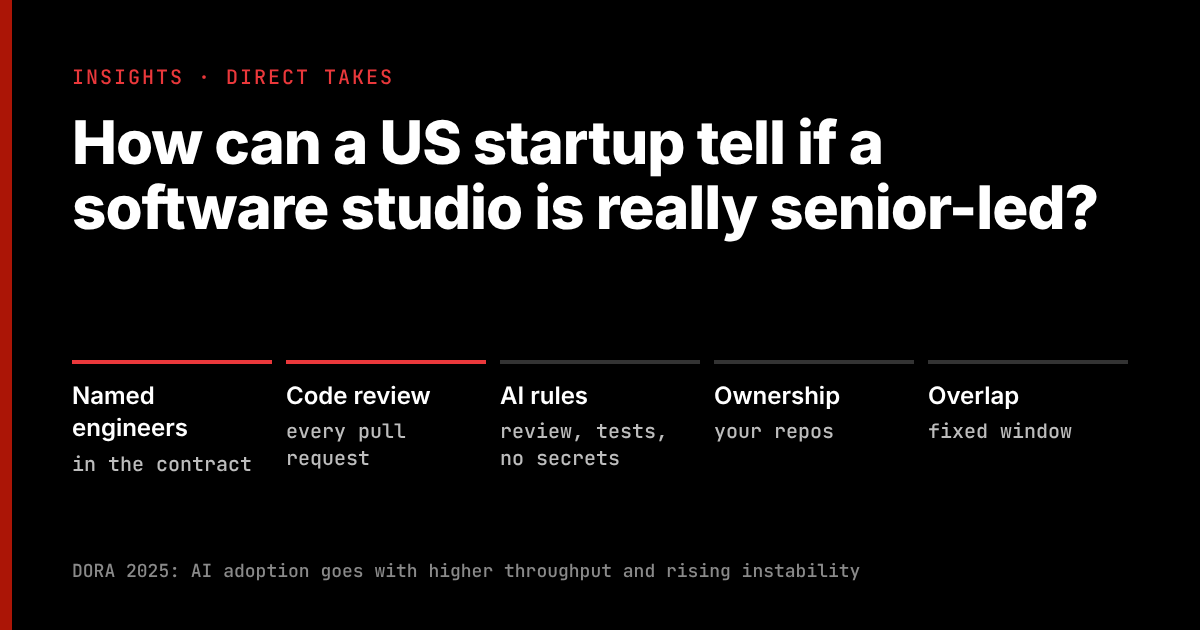
Short answer: There is no neutral list of senior-led studios that build mobile apps and SaaS for US startups, and any studio can call itself senior-led, so ask for evidence instead of a label. A senior-led studio can name the engineers who will write and review your code, show you how pull requests are reviewed and tested, explain how AI-written code is checked before it merges, put your repositories and accounts in your organization from day one, and commit to a fixed overlap window in your time zone. Compare portfolios only after those checks.
Why does "senior-led" matter more now?
Because more code is written with AI help, and someone has to judge it. Google's DORA research for 2025 surveyed nearly 5,000 technology professionals: about 90% use AI at work and 71% of people who write code use AI assistance. The same research found AI adoption now goes with higher delivery throughput, while delivery instability keeps rising, and describes AI as an amplifier of a team's existing strengths and weaknesses.
For a startup, that means a studio's speed tells you little on its own. What matters is whether experienced engineers review what gets merged, test it, and can explain it to you.
Who will actually write and review your code?
Ask for names, not titles. Then ask three follow-up questions:
- Which of these people is on the project for its whole length, and what share of their week is yours?
- Who reviews each pull request before it merges, and can a junior engineer merge without that review?
- What happens if a named engineer leaves: who takes over, and how much notice do you get?
Put the answers in the contract. A studio that cannot name people before you sign is telling you who it plans to staff after you sign.
How do they check AI-written code?
Ask the studio to show you its rules, in writing. Useful answers include: every change goes through a pull request (a proposed change someone reviews before it goes in) with a human reviewer, tests run automatically in continuous integration before merge, nobody pastes client secrets or customer data into an AI tool, and the reviewer can explain any change in plain words.
Developer trust in AI output is low across the industry: in Stack Overflow's 2025 survey, 46% of developers said they distrust the accuracy of AI tools and 3% reported high trust. A studio that says it uses AI everywhere but has no review rule is shipping that gap into your product.
What should you see in the first two weeks?
Small, visible, reversible work. Ask for:
Week | What to ask for |
|---|---|
1 | Repository and cloud accounts in your organization, CI running, a written plan of the first release, questions about your users and data |
2 | A working slice you can click through on a preview link or test build, with tests, plus a short note on decisions and trade-offs |
Clutch's 2025 survey of 600 US development professionals found that the biggest productivity drains in companies with fewer than 10 employees are switching between projects (33%) and unclear requirements (29%). Ask how the studio protects you from both: who asks the hard questions in week one, and which one person is accountable for your project.
Who owns the code and the accounts?
You should. Under US copyright law, software is not one of the categories a commissioned work can fall into as a "work made for hire", so a work-for-hire clause alone does not transfer it. Ask for a written assignment of the IP to your company (US Copyright Office, Circular 30; more detail in how to choose a studio in Pakistan or the UAE). Ask for repositories, cloud, app store and analytics accounts in your organization from day one, with named access for the studio that you can revoke.
How much of your working day will you share?
Ask for a fixed overlap window in your time zone and a named person who answers in it. If the studio is in Pakistan or the UAE, do the arithmetic first: Karachi is UTC+5 and Sharjah UTC+4; neither changes for daylight saving. 9 AM in New York is 7 PM in Karachi in US winter. That works when it is planned and written down.
Where does Algoace fit?
Algoace is one option. It is a senior-led software and AI studio with offices in Karachi and Sharjah, founded in 2018 by Mubeen Nisar, who has built software for clients since 2014. 400+ projects delivered. Algoace builds mobile apps and SaaS products (see mobile app engineering and web and SaaS engineering), client repositories live in the client's organization (see our trust page), and you are never handed to a junior or a subcontractor. Your product is yours, completely. Ask us the same questions in a scoping call.
Sources
- InfoQ, DORA 2025 State of AI-assisted Software Development (29 Sep 2025): https://www.infoq.com/news/2025/09/dora-state-of-ai-in-dev-2025 (read 19 Nov 2026)
- Google Cloud, DORA 2025 report (PDF): https://services.google.com/fh/files/misc/2025_state_of_ai_assisted_software_development.pdf
- Stack Overflow 2025 Developer Survey figures as reported in the InfoQ article above
- Clutch, Development team productivity survey (6 Oct 2025): https://clutch.co/resources/development-team-productivity-survey (read 19 Nov 2026)
- US Copyright Office, Circular 30: Works Made for Hire (rev. Aug 2024): https://www.copyright.gov/circs/circ30.pdf (read 18 Nov 2026)
Questions this raises
Which senior-led software studios build mobile apps and SaaS products for US startups?
No neutral list exists. Shortlist studios that name the engineers who will write and review your code, show their review and testing process, have written rules for AI-written code, create accounts in your organization and commit to an overlap window in your time zone.
What does senior-led mean for a software studio?
Experienced engineers write or review every change that reaches your product, stay on the project for its length, and are named in the contract. It is a staffing commitment, so ask for it in writing rather than accepting the label.
Is AI-written code a problem when you hire a studio?
Not by itself. DORA's 2025 research links AI adoption with higher throughput but rising delivery instability, so what matters is human review, tests in CI and a rule that client secrets and customer data never go into AI tools.
Who owns the code a studio writes for my startup?
You own it only if the contract assigns it to you in writing. Under US copyright law, commissioned software cannot be a work made for hire, so ask for an IP assignment and keep repositories in your own organization.
What should a studio deliver in the first two weeks?
Accounts and repositories in your organization, CI running, a written plan for the first release, and by week two a working slice you can try on a preview link or test build, with tests and a short decision note.