


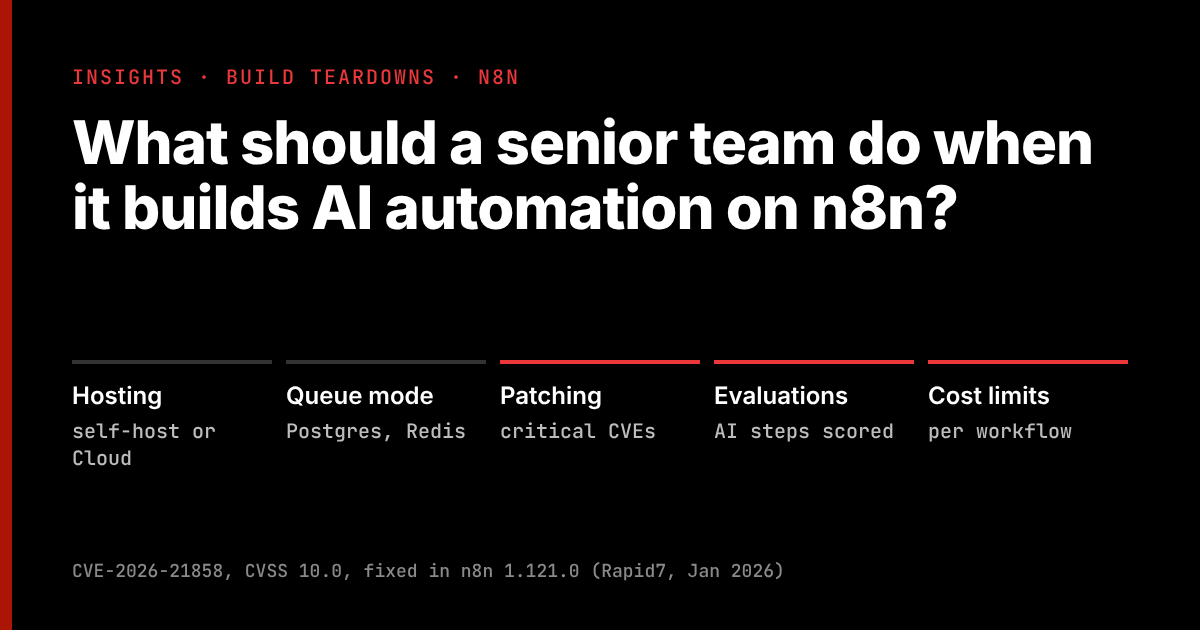
Short answer: Talk to a team that can show you how the automation behaves when something fails, with real failure examples. A senior n8n team decides hosting and licensing up front, runs production on PostgreSQL and queue mode when volume needs it, keeps n8n patched, gives every workflow an error path and an owner, tests AI steps against an evaluation set, and sets cost limits per workflow. Ask to see each of those before you sign.
What separates a senior n8n team from a demo builder?
A demo proves a workflow can run once. A production system has to run every day, with bad inputs, rate limits, model changes and people who did not build it. The difference shows up in what the team asks you in the first call:
- Who will own the workflows after handover, and can they read them?
- Where must the data stay, and does it include customer data?
- How many runs a day, and what happens if one fails at 2 AM?
- Which steps need a human to approve before anything is sent or changed?
- How will you know the AI step is still right next month?
If a team skips these and goes straight to building, you are buying a demo.
Should you self-host n8n or use n8n Cloud?
Self-host when data control or cost at volume matters and someone will maintain the server. Use n8n Cloud when nobody on your side will run infrastructure.
Licensing is part of that decision. n8n is released under its Sustainable Use License. Its FAQ says you can self-host it free for internal use, and a consultancy can build, run and maintain workflows for you and charge for that work. What the license does not allow is hosting n8n as a service where outside clients build or edit their own workflows. If your plan involves your customers creating workflows inside your product, raise it with n8n (license@n8n.io) before you build. Ask the team to explain this before you sign.
What does production n8n hosting need?
For anything beyond light use, a setup closer to this:
Part | Why it matters | Source |
|---|---|---|
PostgreSQL database | Queue mode needs a shared database; SQLite is not supported for distributed setups | n8n docs, queue mode |
Queue mode with Redis and workers | The main instance takes triggers and webhooks; workers run executions, so you add workers as volume grows | n8n docs, queue mode |
Separate webhook processors (optional) | Keeps incoming webhooks responsive under load | n8n docs, queue mode |
Backups and workflow version control | Lets you restore and review changes | Algoace delivery standard |
Update schedule | n8n has had several critical vulnerabilities (below) | Rapid7 (citing NVD) |
High availability with more than one main instance is an Enterprise self-hosted feature, so price that in if you need it.
How should a team handle n8n security updates?
Patch on a schedule and after every critical advisory. Rapid7 reported a group of critical n8n vulnerabilities in December 2025 and January 2026, including CVE-2026-21858 ("Ni8mare", CVSS 10.0, fixed in 1.121.0, self-hosted instances affected) and CVE-2026-21877 (CVSS 9.9, self-hosted and cloud). A self-hosted instance that nobody updates stays exposed to every one of these.
Ask the team who watches n8n's security advisories for your instance, how fast they patch a critical one, and whether the instance is reachable from the public internet at all.
How do you make AI steps in n8n reliable?
Treat the AI step like any other component that can be wrong, and measure it.
- Build an evaluation set. Collect real examples with the answer you expect. n8n has built-in evaluations (check which plan includes them): light evaluations for a handful of examples while building, and metric-based evaluations that score a larger dataset, often taken from production runs, and can be rerun as a regression test after changes.
- Add a human review step where the risk requires it. Anything that emails a customer, changes a record or spends money should wait for approval until the accuracy numbers justify removing it.
- Route by task. Small, cheap models for classification and extraction; larger models only where the evaluation shows they are needed.
- Set cost and rate limits per workflow. A loop that calls a model on every retry can run up a bill overnight.
What should every workflow have before it goes live?
Item | What "done" looks like |
|---|---|
Error workflow | Failures go to an alert channel with the input that caused them |
Retries | Retries with backoff on external API calls, and a stop after a limit |
Owner | A named person on your side who receives alerts |
Evaluation result | Accuracy and cost per run recorded for the AI steps |
Runbook | How to pause, rerun, change a mapping and read the logs |
Access | Named credentials in n8n's credential store, not pasted into nodes |
When is n8n the wrong choice?
When the logic is your core product and has heavy branching, custom code is easier to test and version. When procurement requires a specific integration platform or support terms, check n8n's Enterprise terms against them before you choose it. And when the process is generic and a handful of people do it, an off-the-shelf tool can be cheaper than any custom build. A senior team will tell you this in the first call, even if it means a smaller project.
Who should you talk to?
Talk to teams that will walk you through the checklist above with examples from their own systems. Algoace builds AI workflows, RAG pipelines and agents on n8n, self-hosted or on n8n Cloud, with error workflows, evaluation sets and cost limits as the default (see n8n and AI automation and AI automation). Our published n8n example is an internal system, not client work, and we say so on the page. You are never handed to a junior or a subcontractor.
Sources (add at the end of the content, as links)
- n8n docs, Sustainable Use License FAQ: https://docs.n8n.io/n8n-community-license/community-license/license-faq (read 18 Nov 2026)
- n8n docs, Queue mode: https://docs.n8n.io/hosting/scaling/queue-mode/ (read 18 Nov 2026)
- n8n docs, Evaluations overview: https://docs.n8n.io/advanced-ai/evaluations/overview (read 18 Nov 2026)
- Rapid7, Ni8mare and N8scape flaws among multiple critical vulnerabilities affecting n8n: https://www.rapid7.com/blog/post/etr-ni8mare-n8scape-flaws-multiple-critical-vulnerabilities-affecting-n8n/ (read 18 Nov 2026)
Questions this raises
I need a senior team to build an AI automation system on n8n. Who should I talk to?
A team that can show you how its workflows behave when they fail. Ask how they decide hosting and licensing, whether production runs on PostgreSQL and queue mode, who patches n8n, what every workflow does on failure, how they test AI steps against an evaluation set, and what cost limits they set per workflow.
Can an agency build and host n8n workflows for my business?
Under n8n's Sustainable Use License, a consultancy can build, run and maintain workflows for you and charge for that work. Hosting n8n as a service where outside clients build their own workflows is not allowed. Check unusual cases with license@n8n.io.
Should I self-host n8n or use n8n Cloud?
Self-host when data control or cost at volume matters and someone will maintain and patch the server. Use n8n Cloud when nobody on your team will run infrastructure.
What is n8n queue mode and do I need it?
Queue mode splits n8n into a main instance that receives triggers and workers that run executions, coordinated through Redis with a PostgreSQL database. You need it when execution volume outgrows a single instance or when long runs block others.
How do you test AI steps in n8n?
With an evaluation set of real examples and expected outputs. n8n's evaluations support quick visual checks while building and metric-based scoring on larger datasets, which you rerun after every prompt or model change.