


Short answer: Most subscription apps make their sale on the day of install, so when installs don't pay, the cause is usually inside the first session, not in the ads. Check four things in order: where the paywall sits, whether the app shows its value before asking, how long the trial is, and what happens in the first 24 hours of a trial. 400+ projects delivered since 2014.
When do subscription app users decide to pay?
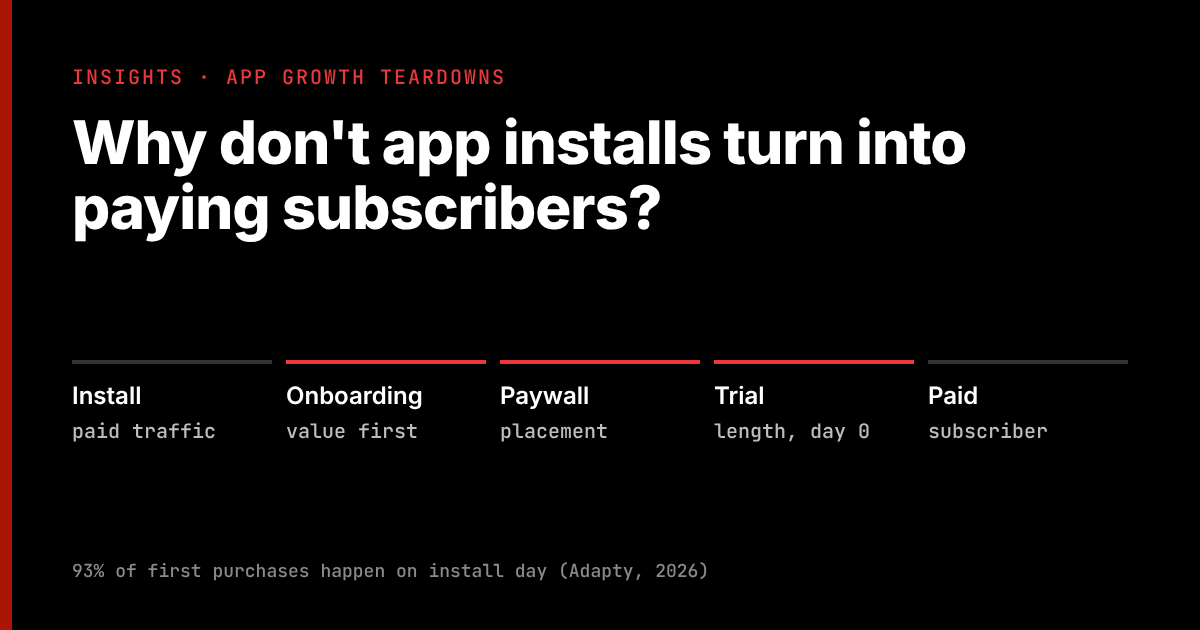
Almost always on day one. Adapty's State of Paywalls 2026 (78,000+ paywalls from 30,000+ apps, October 2025 to September 2026) found that 93% of first purchases happen on the day of install, 60% of buyers buy on the first paywall they see and another 15% on the second.
That changes where you look. If a user leaves the first session without a trial or a purchase, the odds of a later sale are small. More installs feed the same leak.
Does a hard paywall convert better than freemium?
On first purchase, yes, by a wide margin. RevenueCat's State of Subscription Apps 2026 (115,000+ apps, more than $16 billion in revenue) reports a median day 35 conversion of 10.7% for hard paywall apps and 2.1% for freemium apps, and day 60 revenue per install of $3.09 against $0.38.
Freemium is not wrong. It suits apps whose free tier brings users back daily and creates a later reason to upgrade. But a freemium app needs a deliberate upgrade moment, because the default outcome is a free user who never sees a second paywall.
What to check | What the 2026 data says | Source |
|---|---|---|
When users buy | 93% of first purchases on install day | Adapty, Oct 2026 |
Paywall placement | 0.85% view to paid during onboarding vs 0.23% later | Adapty, Oct 2026 |
Paywall model | Day 35 conversion 10.7% hard paywall vs 2.1% freemium (medians) | RevenueCat, Mar 2026 |
Trial length | Trial to paid 42.5% for 17 to 32 day trials vs 25.5% under 4 days | RevenueCat, Mar 2026 |
Early cancellations | 44% of trials cancelled within 24 hours (US 40%) | Adapty, Oct 2026 |
Where should the paywall sit in onboarding?
Inside onboarding, after the app has shown what it does. Adapty measured a median 0.85% view to paid for onboarding paywalls against 0.23% for paywalls seen later. In Lazyweb's review of 40 onboarding flows with a paywall, 77.5% placed it in the final third of onboarding and none placed it on the first screen.
The pattern behind both numbers: ask for the purchase while intent is highest, but only after the user has seen something made for them (a plan, a result, a sample). A paywall on screen one asks people to pay for a promise.
Is your free trial too short?
Often. RevenueCat found a median trial to paid of 42.5% for trials of 17 to 32 days against 25.5% for trials under 4 days, and 55.4% of 3-day trial cancellations happen on day 0. Short trials give a user one evening to see value, and many cancel before they try.
Longer is not automatically better for revenue, because a longer trial delays cash and can lower trial starts. Test it: run the current trial against a longer one on the same traffic and compare paid subscribers per install, not trial starts.
What should happen in the first 24 hours of a trial?
Give the user a second reason to stay before they think about cancelling. Adapty reports that 44% of trials are cancelled within 24 hours, about 32% within the first hour. Users who cancel that fast usually have not reached the core action yet.
Useful moves in that window:
- Send the user straight into the core action after the trial starts, not back to a home screen.
- Ask for notification permission after that first value moment, with a reason the user wants (a reminder they set).
- Show what the trial includes and when it ends, so cancellation is not the only way to feel in control.
How do you find your own leak?
Before you change ads, measure four rates from the last 30 days, split by acquisition source:
- Install to onboarding complete.
- Onboarding complete to paywall view.
- Paywall view to trial or purchase.
- Trial to paid.
The lowest rate against its benchmark is where to work first. Change one thing at a time and run it as a controlled test in your subscription platform (RevenueCat, Adapty or Superwall), so the result is read in your own account. Our app growth diagnostic walks through the same funnel.
Algoace builds subscription apps and runs their paid growth, so the team that reads the funnel can also ship the fix. You are never handed to a junior or a subcontractor. See app growth marketing.
Sources
- RevenueCat, State of Subscription Apps 2026 summary (19 Mar 2026, updated 22 Apr 2026): https://www.revenuecat.com/blog/growth/subscription-app-trends-benchmarks-2026 (read 13 Nov 2026)
- Adapty, State of Paywalls 2026 (16 Oct 2026): https://adapty.io/state-of-paywalls/report/ (read 13 Nov 2026)
- Lazyweb, How far into onboarding do apps place the paywall (7 Jul 2026): https://design.lazyweb.com/blog/how-far-into-onboarding-do-apps-place-the-paywall.md (read 13 Nov 2026)
Questions this raises
Why are my app installs cheap but users don't pay?
Cheap installs often come from broad audiences, but the bigger cause is usually the first session. 93% of first purchases happen on install day (Adapty, 2026), so check paywall placement, value before the ask and trial length before buying more traffic.
What is a good install to paid conversion rate for a subscription app?
It depends on the model. RevenueCat's 2026 medians are 10.7% by day 35 for hard paywall apps and 2.1% for freemium apps. Compare your app with the median for its own model and category.
Should the paywall be in onboarding?
For most subscription apps, yes, near the end of onboarding and after the app shows its value. Adapty measured 0.85% view to paid for onboarding paywalls against 0.23% for later paywalls.
Is a 3-day free trial too short?
Often. RevenueCat found 25.5% trial to paid for trials under 4 days against 42.5% for 17 to 32 days, and most 3-day cancellations happen on day 0. Test a longer trial on the same traffic before switching.
Should I spend more on ads if installs don't convert?
Not first. More installs feed the same leak. Measure install to onboarding, onboarding to paywall, paywall to trial and trial to paid, fix the weakest step, then scale spend.